It usually happens with a bang or a horrible scraping lean: the sliding door has come off its track. The panel is a hundred pounds of glass in a frame, now resting wrong, and the next ten minutes decide whether this is a service call or a service call plus a track, plus glass. Here is the calm sequence.
Step 1: Stop. Do not force it.
Every instinct says to shove the door back into place. Resist. A derailed panel forced along the sill bends the track edge, tears the bottom rail, cracks roller housings and can stress the glass at its corners — converting a reseating job into parts and possibly a panel. Equally, do not keep using the door "carefully" for a week: each dragging pass machines the track a little more. The door is out of service until it is reseated; treat that as settled and the rest is easy.
Step 2: Make it safe and upright
If the panel is leaning, get a second adult. Together, stand the panel upright and stable — resting squarely on the sill, not tilted against the frame — and chock or hold it so it cannot topple. Glass panels are at their most fragile leaning at an angle with a corner loaded. Clear children and pets from the room; if the door is an entry point, plan to secure the opening once the panel is stable (a bar in the track, the lock if it still engages, or simply the household staying aware tonight). Nothing else in this guide matters more than nobody getting hurt by a falling panel.
Step 3: Read the scene like a technician
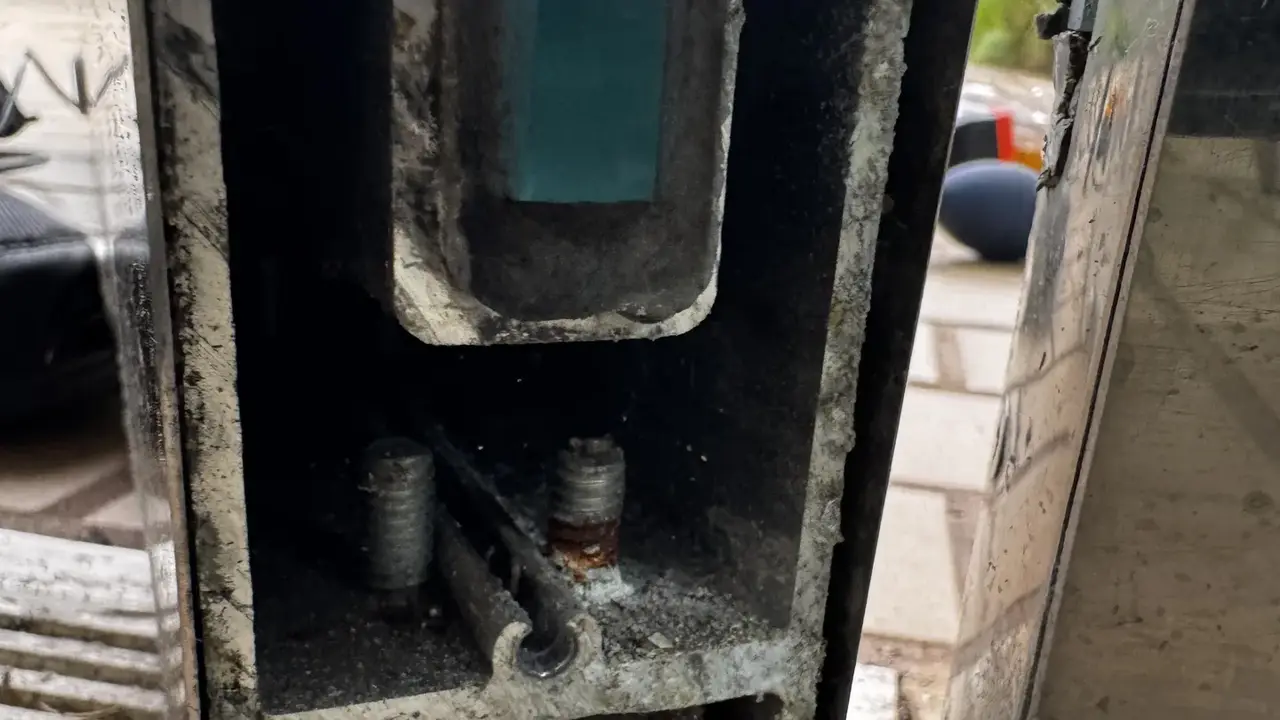
With the panel stable, look before touching. Is one end off and the other on — the classic single-roller jump? Is the whole panel sitting in front of or behind the track? What is in the track: a toy, a stone, a chunk of the roller itself? Has the wheel come off its housing, or the housing out of the door? Photograph what you find; that picture, sent or described when you call, lets us arrive with the right parts. Causes sort into three families: obstruction (something in the track threw the wheel), wear (a collapsed or flat roller dropped the panel until it could climb out), and height (a panel adjusted too low or lifted — by wind, by a lift attempt, by a child swinging on it — until the wheels cleared the rail).
Step 4: The reseat — only if it is simple, only with help
If the cause is an obvious obstruction and the rollers look intact, a reseat is a two-person lift: clear the track completely, then lift the panel straight up into the head track's deep channel, swing the bottom over the rail, and lower it onto the track — up, over, down, in that order, communicating throughout. Then roll it slowly through its full travel. Smooth and seated: you are done, and the door goes on the tune-up list to find out why it could jump. Grinding, rocking or a panel that will not sit level: stop. The rollers or track are damaged, and rolling on them now is how tracks get ruined. Call it in as it sits.
What the service visit does differently
When we reseat a derailed door, the panel comes fully out and the diagnosis happens with everything visible: roller condition, housing integrity, track straightness and surface, guide condition, and the panel's height setting — the full mechanical picture. Parts are replaced if the jump broke or revealed them, the track is capped if the derailment dented it, and the height is set with the anti-lift margin correct, so the door cannot casually do this again. A door that has jumped once has told you something; the visit's job is to hear all of it, not just the loud part.
Prevention, briefly
Doors jump tracks for reasons that accumulate quietly: worn rollers riding lower each year, tracks filling with grit that a wheel finally climbs, guides loosening, children treating the panel as playground equipment. The standing defenses are the care routine (clean track, early attention to new sounds), prompt roller replacement at the first flat-spot bump, and correct height with anti-lift clearance respected. A maintained door, honestly, almost never derails. When one does, you now know the sequence: stop, stabilize, look, and lift only if it is simple. The panel — and the track, and the glass — will thank you for the restraint.